If your business is moving goods into Zimbabwe, customs clearance is one of the most important parts of the entire shipment process.
It is the point where your cargo is declared, assessed, and either released efficiently or delayed because something in the paperwork, payment, or border process is not aligned. For importers, that means customs is not just an admin step. It directly affects timelines, landed cost, and supply chain reliability. Zimbabwe’s system is now highly digital, more structured than before, and shaped by recent regulatory changes that importers need to understand before cargo reaches the border.
What customs clearance actually means
In simple terms, customs clearance is the process of declaring imported goods to the Zimbabwe Revenue Authority so that duties, taxes, and compliance requirements can be checked before the goods are released.
In practice, that means customs needs to know what the goods are, what they are worth, where they came from, and whether any permits, certificates, or other controls apply. Zimbabwe’s official customs clearance procedures and its ASYCUDA World system sit at the centre of this process, and by 2026 the system is effectively paperless for commercial cargo, with supporting documents scanned and submitted electronically.
Why this matters more now than it used to
The process has become more time-sensitive because Zimbabwe now relies heavily on digital submission, pre-clearance, and payment controls. That creates more structure, but it also means there is less room for late preparation.
A major change came with the February 2026 move to Payment After Assessment. Instead of relying on the old pre-payment model, duties and taxes are now paid only after customs has assessed the entry and issued an assessment notice. That means your goods cannot move to final release until payment has been made through the approved channels. For importers, cash-flow readiness and timing now matter more than before.
The core documents you need to get right
Most delays in customs clearance happen because documentation is incomplete, inconsistent, or submitted too late.
For a standard commercial import, the core document pack usually includes:
- a commercial invoice
- a packing list
- the Bill of Entry
- freight and insurance statements
- transport documents such as a waybill or consignment note
- a certificate of origin where preferential rates are being claimed
- any permits or approvals required for controlled goods
These are not just formalities. They are what customs uses to assess the goods, calculate the duty base, verify compliance, and decide whether the shipment can move. Zimbabwe also maintains permit requirements for certain categories of goods, and if your cargo falls outside open general licensing arrangements, additional approvals may be required from the relevant authority.
How the customs process works step by step
From an importer’s perspective, the process is easier to manage when broken into stages.
1. Documents are prepared and submitted before arrival
Zimbabwe enforces a pre-clearance approach for road freight, which means the documentation needs to be submitted before the truck reaches the border. If that has not happened, the cargo may be held while the system catches up.
2. Customs assesses the declaration
Once the Bill of Entry and supporting documents are in the system, customs reviews the entry and calculates the duties and taxes payable. Risk profiling also happens at this point through ASYCUDA’s selectivity system.
3. Duties and taxes are paid
Under the Payment After Assessment model, payment happens only after the entry has been assessed. This is one of the most important planning points in the modern Zimbabwe import process because delays in payment now translate directly into delays in release.
4. Cargo may be inspected
Some shipments are released quickly, while others are selected for documentary checks or physical examination. Zimbabwe uses risk-based selectivity lanes, including green, yellow, red, and blue outcomes, with different levels of control attached to each.
5. Cargo is released
Once the system requirements are satisfied and any inspection is completed, the shipment can be released and continue its journey.
How duties and taxes are calculated
One of the most important things importers need to understand is that duty is not calculated on the goods value alone.
Zimbabwe calculates duty on a CIF basis, which means the Value for Duty Purposes includes the cost of the goods, insurance, and freight up to the border. VAT is then calculated on top of the dutiable base, and in 2026 the standard VAT rate is 15.5%. That means poor planning around transport cost, insurance, or declared value can materially affect the total landed cost of the shipment.
The role of clearing agents
Most businesses do not manage this process themselves, and realistically, they should not try to.
Zimbabwe strongly encourages commercial entities to use licensed professionals because customs classification, valuation, permits, and system requirements are too important to treat casually. Clearing agents are responsible for preparing and lodging entries, coordinating with customs, managing compliance requirements, and helping move the cargo through release. ZIMRA also publishes a list of licensed clearing agents, which is useful when vetting service providers.
This is also where NET Logistics becomes important beyond just moving the truck. At NET Logistics, we coordinate closely with clearing teams, border processes, and transport planning so that the shipment is aligned before it reaches the border. In practice, that often makes the difference between cargo that moves predictably and cargo that sits waiting while paperwork, payment, or release catches up.
Where delays usually happen
Importers often assume the main risk is the road journey itself, but in many cases the bigger delays happen at the border.
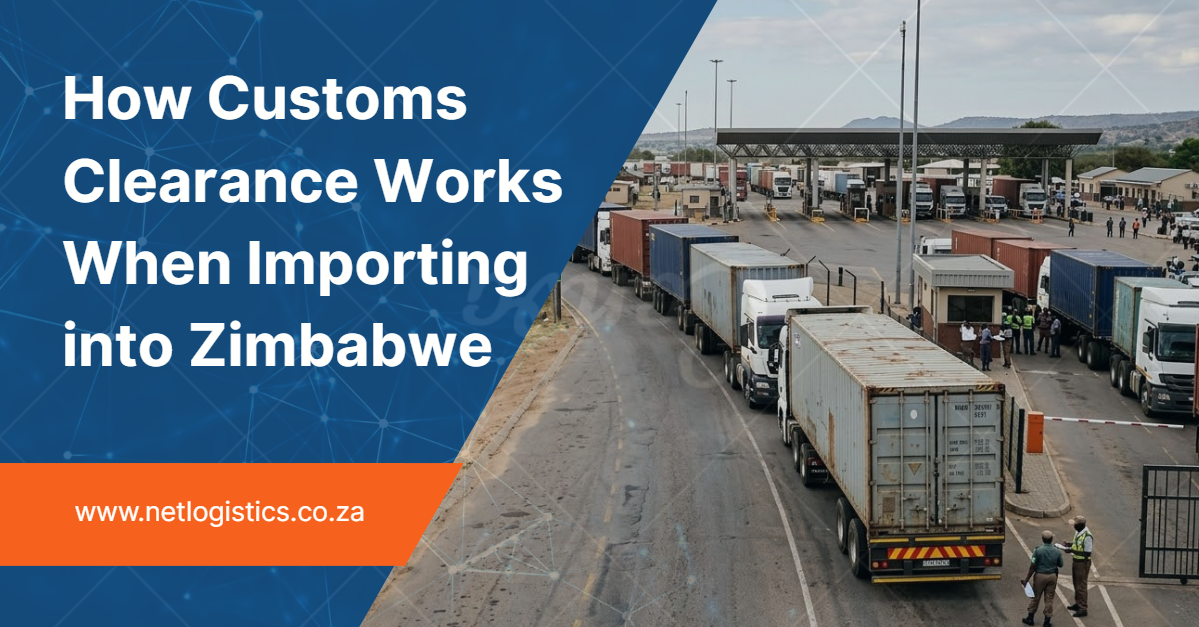
Beitbridge remains the main link between South Africa and Zimbabwe, and despite infrastructure upgrades, it still experiences significant congestion. The research you provided notes that in March 2026, transit times for heavy goods vehicles had increased sharply, with delays in some cases reaching up to seven days. Congestion is often worsened by incomplete documentation, poor coordination, and pressure from peak traffic periods.
There are also delays linked to inspections, late duty payment, and system-related timing. That is why businesses relying on transport to Zimbabwe need to plan beyond just departure and arrival dates. Border timing is part of the shipment, not an afterthought.
What importers should do to reduce delays
The good news is that many customs problems are preventable.
The businesses that move goods into Zimbabwe most smoothly usually do a few things consistently well. They prepare documents early, confirm values accurately, understand whether permits apply, make sure payment can happen quickly after assessment, and work with partners who understand how the border actually functions in practice.
If your cargo includes regulated goods, it is also worth checking whether conformity or licensing requirements apply before dispatch. Depending on the cargo category, you may need import licensing or pre-shipment compliance processes such as the CBCA programme before goods are even eligible for smooth entry.
Why working with the right logistics partner matters
For most importers, the real issue is not learning every customs rule from scratch. It is making sure the right people are managing the moving parts before those moving parts become delays.
That means working with a logistics partner who understands the border process, the clearance sequence, the documentation requirements, and the practical realities of cross-border movement. NET Logistics supports businesses moving cargo into Zimbabwe by helping align transport planning with customs readiness, so that shipments are not only dispatched, but actually prepared to clear.
If your business needs reliable cross-border freight into Zimbabwe, or you want clarity on how a specific shipment should be prepared, the smartest next step is to contact NET Logistics before the truck is on the road.
Customs clearance in Zimbabwe is not just a formal checkpoint. It is a critical part of your supply chain.
When it is handled properly, goods move with fewer surprises, more predictable timing, and better cost control. When it is handled badly, the border becomes where time, money, and planning start leaking out of the shipment.
For businesses importing into Zimbabwe, the practical lesson is simple: prepare early, document accurately, align payment timing, and work with people who understand the process from both the customs side and the transport side. That is how you reduce avoidable delays and keep cargo moving.