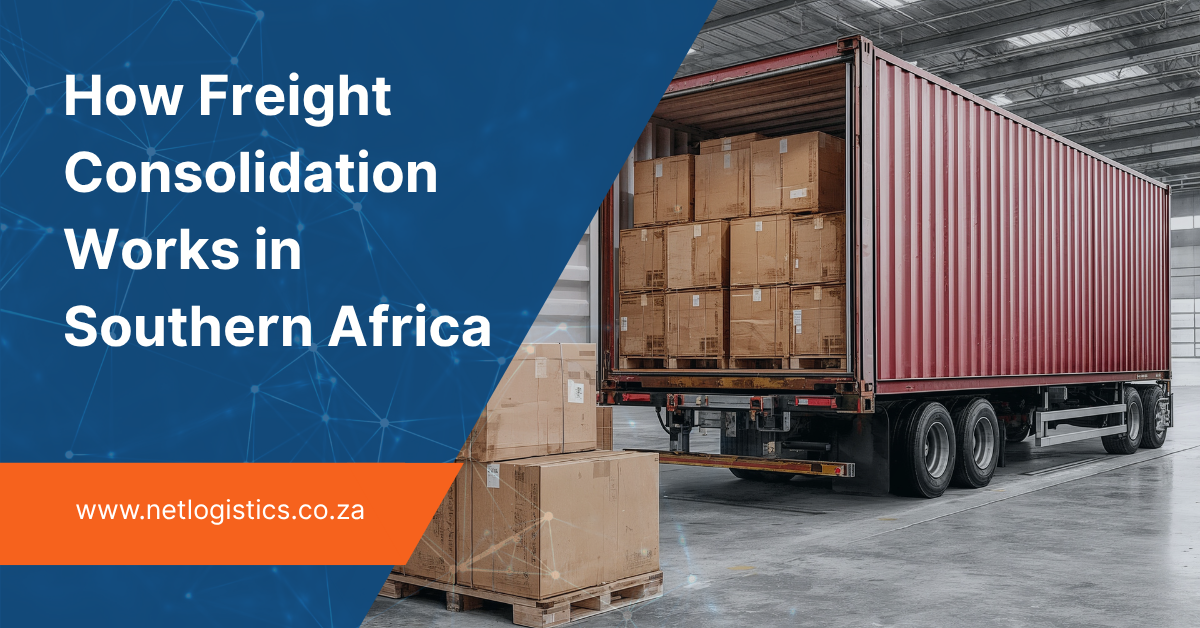
Freight consolidation in Southern Africa is one of those terms that gets used constantly in logistics conversations but rarely explained properly. Most businesses know it means sharing a truck with other consignments. Fewer understand what that actually involves operationally — the load tray, the documentation complexity, the hub process, or what genuinely determines whether consolidation is the right model for their cargo.
This post explains the mechanics. How consolidated cross-border freight is built, moved, and cleared. What happens at the consolidation hub before a truck ever leaves Johannesburg. And how to know whether consolidation is the right choice for your shipment — or whether a dedicated truck makes more sense.
What Freight Consolidation Actually Means in a Cross-Border Context
Freight consolidation — also known as LTL (Less Than Truckload) or groupage — is the practice of combining multiple smaller shipments from different businesses onto a single truck, all heading to the same destination region.
In a domestic setting, the concept is relatively straightforward. Cross-border consolidation is more complex. Each consignment on the truck belongs to a different business, clears customs under its own documentation, and is the legal responsibility of a different importer. A single consolidated truck heading from Johannesburg to Lusaka might be carrying goods for eight or ten different companies simultaneously — and each of those companies needs its shipment processed correctly at the border without being affected by the others.
This is what separates a competent cross-border consolidator from a domestic freight company trying to run SADC routes. The mechanics of building and clearing a consolidated load across two international borders require a level of operational discipline that goes well beyond simply filling a truck with mixed cargo.
How the Load Tray Process Works — Step by Step
The load tray is the planning and assembly phase of consolidated freight. It is where the truck is built — logistically and documentarily — before it moves.
At NET Logistics, the process works as follows:
1. Cargo receipt and measurement: Consignments arrive at the Johannesburg consolidation warehouse in Boksburg. Each shipment is received, weighed, measured, and checked against the client’s documentation. Volumetric weight is calculated — because in consolidated freight, you pay for the space your cargo occupies, and that space is determined by whichever is greater: actual weight or volume.
2. Labelling and staging: Each consignment is labelled with the consignor, consignee, destination region, and pallet count. This is not a minor administrative step — it is what makes the truck traceable and each consignment identifiable at the border and on delivery.
3. Compatibility grouping: Not all cargo can travel together. General cargo, HAZCHEM loads, and temperature-sensitive goods each have requirements that affect what can be loaded alongside them. Load planners group compatible consignments and plan the physical layout of the truck to ensure safe and compliant loading.
4. Documentation assembly: While cargo is being staged physically, the documentation set for each consignment is being prepared simultaneously. This includes commercial invoices, packing lists, road manifests, certificates of origin, and any regulated permits. SADC certificates — which enable preferential tariff treatment under the SADC Trade Protocol — must be stamped before the truck is dispatched.
5. Manifesting: Once the full load is confirmed, an official truck manifest is prepared listing every consignment on board — each client’s cargo, documents, and destination details. This master document travels with the truck and is presented at every border crossing.
The load tray process typically takes up to three days, depending on cargo volumes and how quickly all consignments arrive at the warehouse. This is not downtime — it is the compliance and planning work that determines whether the subsequent transit runs cleanly or not.
Documentation on a Consolidated Load: What Makes It Different
On a full truck charter, one business owns all the cargo and clears it under a single set of documents. On a consolidated load, each consignment clears independently — under its own invoice, its own certificate of origin, its own permits — while physically sharing space on the same vehicle.
This creates a documentation management challenge that is unique to consolidation. The core documents for each consignment on a cross-border consolidated load include:
- Commercial invoice (per consignee)
- Packing list (per consignee)
- Road manifest / waybill (per consignee)
- Certificate of Origin — relevant for SADC preferential duty rates, obtained through SARS or relevant industry bodies
- Any regulated permits specific to that cargo type
The master truck manifest ties all of these together into a single document that customs authorities use to verify the full load. If one consignment’s documents are incorrect or incomplete, it can hold the entire truck at the border while the issue is resolved.
This is why pre-clearance matters so much on consolidated loads. At NET Logistics, documents are submitted to customs authorities ahead of the truck’s arrival — giving time to identify and resolve any discrepancies before the truck is in the queue. For a deeper look at the specific documents required for cross-border shipments in Southern Africa, see our post on the top customs clearance documents for shipping in Southern Africa.
How a Consolidation Hub Operates
The consolidation warehouse is the operational nerve centre of the entire model. Without a properly equipped hub, consolidated cross-border freight doesn’t work — it just produces trucks loaded with mixed cargo and a documentation mess at the border.
NET Logistics operates a 2,800m² consolidation warehouse in Bartlett, Boksburg — centrally positioned in Johannesburg for collection from suppliers across Gauteng. The facility is equipped with forklifts, automated packing and labelling equipment, and a fully secured HAZCHEM yard for hazardous cargo.
The hub performs several functions that directly affect shipment quality:
Receiving and verification — every consignment is checked against its documentation on arrival. Discrepancies are identified and resolved here, not at the border.
Secure storage — cargo is held securely while the load tray is assembled. Goods-in-Transit insurance covers the load during this period.
Load optimisation — physical planning of how cargo is arranged on the truck affects both safety and efficiency. Dense, heavy cargo is positioned differently from fragile or bulky goods. This is not guesswork — it is a planned process carried out by experienced warehouse staff.
Dispatch readiness — the truck leaves the hub only when every consignment is physically loaded, every document is in order, and the manifest has been compiled. Nothing moves until the load is complete and compliant.
For a breakdown of what these hub operations cost and how consolidation fees are structured, see our post on freight consolidation fees explained.
Consolidation vs Full Truck: How to Know Which One You Need
The consolidation model is cost-effective for smaller shipments precisely because the transport cost is shared. But it is not always the right choice. The decision between consolidated freight and a full truck charter comes down to five factors:
| Factor | Consolidation (LTL) | Full Truck (FTL) |
|---|---|---|
| Shipment volume | Partial load — you don’t fill a truck | Full or near-full truck load |
| Cost structure | Pay for space used | Pay for the whole truck |
| Transit flexibility | Departs on the consolidator’s schedule | Departs when you’re ready |
| Cargo sensitivity | Standard general cargo | High-value, fragile, or time-critical |
| HAZCHEM loads | Possible under strict conditions | More straightforward |
As a practical guide: if your shipment is less than roughly half a truck by volume or weight, consolidation will almost always be more cost-effective. If you are regularly shipping volumes that approach or fill a truck, the economics begin to shift — and a dedicated vehicle gives you faster transit, more scheduling control, and reduced handling of your goods.
The break-even point is not fixed. It moves depending on the route, the urgency of the delivery, the nature of the cargo, and the frequency of your shipments. If you’re uncertain, the right approach is to get a comparative quote for both options and evaluate total landed cost — not just the headline freight rate.
When Consolidation Is Not the Right Choice
Consolidation works well for planned, regular shipments of general cargo where cost efficiency is the priority. It is not the right model in every situation.
Consider a dedicated truck if:
- Your cargo is time-critical. A consolidated truck departs on a schedule determined by when the load tray is full. If you need a truck on the road on a specific day regardless of what else is available, dedicated is the more reliable option.
- Your cargo is high-value or fragile. More handling means more exposure. FTL shipments are loaded once and unloaded at the destination — consolidated loads involve staging, transfer, and handling at the hub.
- Your consignment requires specialised equipment that cannot be shared with general cargo — certain abnormal loads, project cargo requiring custom rigging, or oversized freight.
- Cargo incompatibility. Certain HAZCHEM loads cannot be consolidated with general cargo. If your goods fall into this category, a dedicated vehicle is necessary.
HAZCHEM and Consolidated Freight: What You Need to Know
Hazardous cargo can travel on consolidated loads under the right conditions — but the conditions matter.
NET Logistics operates a fully secured HAZCHEM yard at the Boksburg consolidation warehouse, and its fleet is HAZCHEM-certified across all vehicle sizes. Hazardous goods can be consolidated with compatible cargo where regulations permit, but the compatibility assessment is non-negotiable. IATA Dangerous Goods Regulations and South African road transport regulations govern what can travel alongside what, and the consolidation load plan must reflect this.
For businesses shipping chemicals, cleaning agents, industrial fluids, or other regulated materials, it is worth having a direct conversation with your freight operator about compatibility before assuming consolidation is available for your specific cargo. The short answer is: it often is. But it needs to be confirmed, not assumed.
For more detail on NET Logistics’ hazardous cargo capabilities, see the transporting hazardous materials service page.
Why the Consolidation Model Was Built for SMEs
The economics of cross-border road freight have historically favoured large importers. A business that can fill a 34-ton truck from a single order gets the most competitive per-unit transport cost, the most scheduling control, and the simplest documentation process. A business shipping one or two pallets to Lusaka every fortnight gets none of that — unless a consolidation model makes it available to them.
That is the structural purpose of freight consolidation. It converts a fixed transport cost — a truck that costs the same whether it’s full or half-empty — into a variable cost that scales with your shipment. Small and medium businesses access the same routes, the same departure frequencies, and the same professional customs clearance that large importers use, at a cost proportional to what they’re actually shipping.
For SMEs importing goods into Zimbabwe or Zambia from South Africa, consolidation is often the model that makes the trade lane viable. Regular, reliable departures on a shared truck mean you don’t need to accumulate a full truckload before goods can move — you can ship what you have, when you have it, on a schedule that keeps your supply chain moving.
If you’re exploring the Zambia corridor specifically, our SME starter guide to shipping to Zambia from South Africa covers the commercial and route fundamentals in detail.
Want to understand what consolidation would cost for your specific shipment?
NET Logistics runs consolidated freight services from its Johannesburg warehouse into Zimbabwe and Zambia, with regular scheduled departures and a fleet certified for both general and hazardous cargo. Contact us for a transparent, itemised quote.
📞 (011) 826 7176 ✉️ pierre@newent.co.za 🌐 www.netlogistics.co.za