
Importing goods into Zambia from South Africa is one of the most active trade lanes in the SADC region — and one of the most consistently misunderstood. Zambia’s mining sector runs on consumables and equipment from South Africa. Its retail sector depends on a steady flow of manufactured goods. Its agricultural industry needs inputs, machinery, and chemicals that largely originate in Johannesburg. For businesses shipping into Zambia, demand is real and reliable — but the corridor between South Africa and Lusaka requires careful planning.
This guide covers what importers need to understand before their first shipment moves: the border crossing, the documentation, how the Zambia Revenue Authority processes imports, what duties to plan for, and what typically causes delays. If you’re already shipping to Zambia and things aren’t running as smoothly as they should, much of this will be useful too.
If you’re new to the corridor entirely, it’s worth reading our SME starter guide to shipping to Zambia from South Africa alongside this post — that one covers the commercial and cost fundamentals; this one goes deeper on the operational and compliance layer.
The Zambia Corridor: Why It’s More Complex Than It Looks
Zambia is landlocked. Every consignment moving by road from South Africa must cross international borders before reaching Lusaka — and each border has its own customs authority, documentation requirements, and processing times.
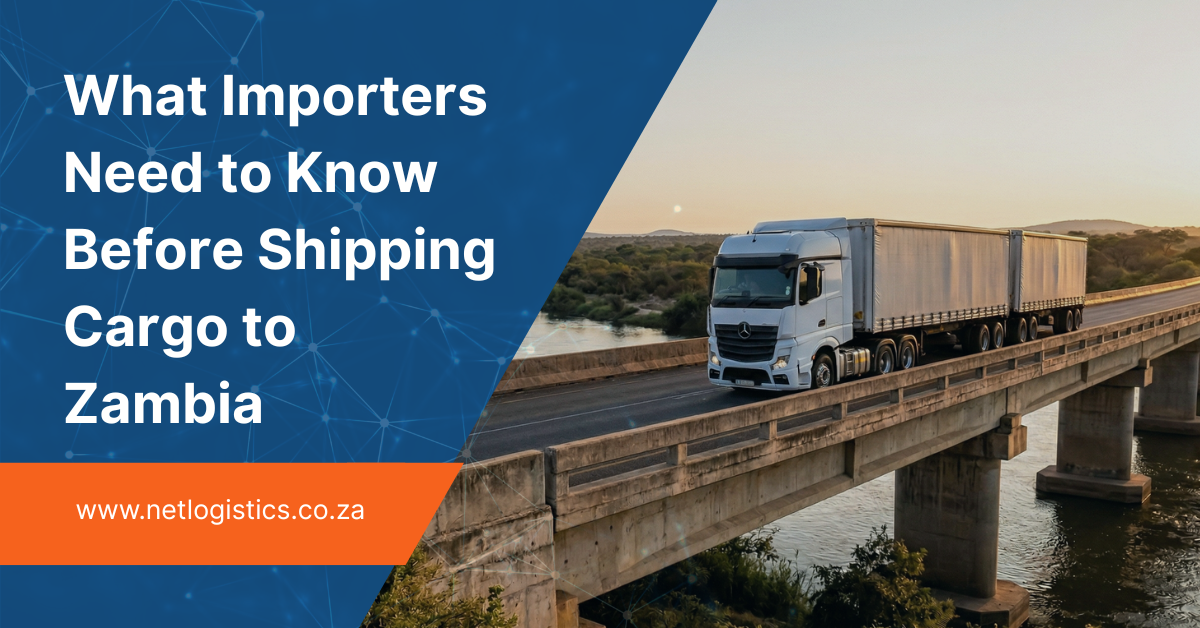
NET Logistics operates the Johannesburg–Groblersbrug–Kazungula route into Zambia. This corridor runs north from Johannesburg through Botswana, bypassing Zimbabwe entirely, before crossing the Zambezi into Zambia at Kazungula. It is a well-established freight route that avoids the congestion risks associated with the Zimbabwe transit leg and benefits from Botswana’s generally reliable road infrastructure.
One important operational note for importers planning shipments on this route: trucks travelling through Botswana are not permitted to operate after 16:00 on weekends. This is a fixed constraint that affects scheduling, and any realistic transit plan needs to account for it.
Add to this Zambia’s own import compliance framework — administered by the Zambia Revenue Authority (ZRA) — and you have a corridor that rewards preparation and punishes shortcuts. Experienced freight operators know exactly what this route requires. First-timers often find out the hard way.
The Kazungula Border Crossing — What Freight Operators Need to Know
Kazungula (Botswana/Zambia)
The Kazungula One Stop Border Post is the primary freight crossing into Zambia on the JHB–Botswana route. The crossing sits on the Zambezi River at the point where Botswana, Zambia, Zimbabwe, and Namibia converge — a genuinely unusual piece of geography. The Kazungula Bridge, completed in May 2021 at a cost of USD 260 million, replaced a slow and unreliable ferry crossing and transformed throughput capacity on this corridor significantly. You can read more about the bridge’s regional significance on the African Development Bank’s project page.
In 2025, Zambia and Botswana formalised an agreement to further upgrade customs infrastructure at Kazungula — expanding truck parking capacity, modernising clearance systems, and introducing a joint border management framework aimed at reducing average crossing times. These improvements are being implemented progressively and will benefit importers using this route over the coming period.
Under normal conditions, importers should plan for border formalities at Kazungula to take two to four hours. Pre-clearance — submitting documentation before the truck arrives — is the most reliable way to compress this. When documents have been approved in advance, trucks can clear significantly faster than those arriving without pre-cleared paperwork.
NET Logistics has a regional office in Lusaka, providing local support for your shipment once it crosses into Zambia.
Documents Your Shipment Cannot Cross Without
Documentation is where most cross-border delays begin. A single missing certificate or an invoice discrepancy can hold a truck at the border for days. The core documents required for commercial road freight into Zambia are:
- Commercial invoice — must reflect accurate goods description, quantity, unit price, and total value in the correct currency. Undervaluation is taken seriously by ZRA and triggers reassessment.
- Packing list — itemised breakdown of contents, weights, and packaging. Must align exactly with the invoice.
- Road manifest / bill of lading — the transport document issued by the carrier, confirming what is on the truck and who it belongs to.
- Certificate of Origin — confirms the country in which goods were produced or substantially transformed. Relevant for SADC preferential tariff rates. South African exporters obtain this through SARS or relevant industry bodies.
- ZRA Form CE 20 — the standard customs entry and exit form used by the Zambia Revenue Authority at all border posts.
- Import Declaration Form (IDF) — required by the Zambian importer for statistical and compliance purposes.
- TPIN confirmation — the Zambian receiver must be registered with ZRA and hold a valid Taxpayer Identification Number. Without this, clearance cannot proceed.
Certain cargo categories require additional permits. Meat imports need certification from Zambia’s Veterinary Department. Plants, seeds, and agricultural produce require a phytosanitary certificate from the Mount Makulu Research Station. Pharmaceuticals and food products require Ministry of Health and Zambia Medicines Regulatory Authority clearance. Firearms require Zambia Police certification.
If your cargo falls into any regulated category, these permits must be in place before the truck moves — not sourced after it arrives at the border.
For a broader overview of the document set required for Southern African cross-border shipping, see our post on the top customs clearance documents for shipping in Southern Africa.
Understanding Zambia’s Customs Process (ZRA and ASYCUDAWorld)
The Zambia Revenue Authority administers all import clearance. For commercial consignments — goods valued above USD 2,000 — clearance is processed electronically through ASYCUDAWorld, Zambia’s automated customs data system.
The process works as follows: a licensed clearing agent submits the customs declaration electronically via ASYCUDAWorld before the cargo reaches the border. The declaration includes all supporting documents — invoice, packing list, manifest, certificates, and permits. ZRA then assesses the duty payable. If the declaration is accepted, a release order is issued. Incorrect declarations trigger additional assessment and automatic penalties.
This is why pre-clearance matters so much. At NET Logistics, documents are submitted to customs at least five days before the truck reaches the border. That five-day window gives ZRA time to process the declaration, flag any issues, and issue a release — so that when the truck arrives, it clears quickly rather than waiting in the queue while paperwork is processed from scratch.
For a step-by-step breakdown of the Zambia customs clearance process specifically, our guide to clearing customs in Zambia covers it in detail.
Duty Rates and How Zambia Calculates What You Owe
Zambia calculates customs duty on a CIF (Cost, Insurance, and Freight) basis — meaning the taxable value includes the price of the goods, plus the cost of insurance and freight to the Zambian port of entry. This is important: it means the freight cost itself forms part of the dutiable value.
Zambia applies three primary tariff bands:
| Goods Category | Duty Rate |
|---|---|
| Capital equipment and raw materials | 0–5% |
| Intermediate goods | 15% |
| Finished goods | 25% |
On top of the customs duty, import VAT of 16% is charged on the combined taxable value (customs value plus customs duty). For finished consumer goods, this means a total tax burden that can approach or exceed 40% of CIF value. Importers who don’t account for this accurately in landed cost calculations will find their margins under pressure.
Certain categories are exempt or zero-rated: medicines and pharmaceuticals, medical equipment, fertilisers, seeds, chemicals in bulk, and agricultural machinery carry zero or very low duty rates. If your goods fall into these categories, confirm the correct HS code with your clearing agent before the shipment moves — the difference between the right and wrong tariff classification can be significant.
Zambia’s tax code is revised annually, so duty rates should be verified against the current ZRA Customs Tariff Book before each shipment cycle.
Realistic Transit Timelines: What to Plan Around
Before a truck moves, there is consolidation work to do. At NET Logistics, the consolidation process — receiving cargo, preparing documentation, and getting SADC certificates stamped — takes approximately three days. This is not dead time; it is the compliance and preparation work that makes the transit itself run smoothly.
Once dispatched, the estimated delivery time from Johannesburg to Lusaka is seven to ten days. That range reflects real variability — border conditions at Kazungula, ZRA processing times, and the weekend driving restrictions in Botswana all play a role in where a given shipment lands within that window.
The breakdown looks roughly like this:
- Day 1–3: Consolidation, documentation preparation, and SADC stamping in Johannesburg
- Day 3–5: Johannesburg to Kazungula via Groblersbrug and Botswana
- Day 5–7: Kazungula border processing and entry into Zambia
- Day 7–10: Lusaka delivery
The weekend driving restriction in Botswana — no truck movement after 16:00 on Saturdays and Sundays — is a fixed variable that can add a day to the transit depending on where in the week a truck departs. Dispatching earlier in the week reduces the likelihood of the restriction affecting your delivery window.
Pre-clearance compresses the Kazungula stage meaningfully. When documents have been submitted and approved before the truck arrives, clearance that might otherwise take 24 hours or more can be completed in a fraction of that time.
Planning your procurement around a ten-day horizon rather than optimistically assuming seven gives your downstream operations a buffer that protects against stockouts and broken commitments to customers.
Five Common Mistakes That Delay Shipments at the Border
1. Invoice values that don’t match the declared goods
ZRA takes customs valuation seriously. Discrepancies between invoice value and market value trigger reassessment, additional duties, and delay. Always declare accurately.
2. Missing or expired regulated permits
Phytosanitary certificates, veterinary clearances, and pharmaceutical permits must be current and in order before departure. There is no fast-track fix at the border if a permit is missing.
3. Receiver not registered with ZRA
The Zambian importer must hold a valid TPIN. If they’re not registered, clearance cannot be processed. This catches new importers who assume their supplier or freight agent can handle it without the receiver’s ZRA compliance being in place.
4. Incorrect HS (Harmonised System) code
The wrong tariff code means the wrong duty rate — and ZRA will correct it, with penalties. Use a clearing agent who knows Zambian tariff classification, not one who guesses.
5. Submitting documents at the border rather than in advance
Electronic pre-clearance through ASYCUDAWorld is how the ZRA system is designed to work. Arriving at Kazungula without pre-cleared documentation means joining the back of the queue while your paperwork enters the system in real time. That can cost a day or more.
How Consolidated Freight Changes the Equation for SMEs
Most SMEs importing goods into Zambia don’t have enough volume to fill a 34-ton truck on their own. That’s where freight consolidation changes the economics of the corridor.
In a consolidated shipment, your cargo shares truck space with other consignments heading to the same destination. You pay for the space you use — measured by weight or volume — not for the whole vehicle. The result is that small and medium businesses get access to regular, reliable freight departures on a schedule that would otherwise only be available to large importers.
NET Logistics runs consolidated freight services into Zambia from its Johannesburg consolidation warehouse in Boksburg, with regular departures and a fleet that includes vehicles certified for general cargo, HAZCHEM loads, and specialised requirements. Shipments are tracked in real time and clients receive daily status updates throughout the journey.
The consolidation model also means documentation is handled collectively — your clearing agent works across the full load rather than you managing every compliance requirement independently. For SMEs without an in-house logistics team, that matters.
For more detail on how consolidation pricing works and what you’re actually paying for, see our post on freight consolidation fees explained.
Ready to move freight into Zambia?
The Zambia corridor rewards businesses that understand it. The documentation requirements are manageable, the customs process is systematic, and the transit times are predictable — when you’re working with a freight partner who knows the route.
NET Logistics operates daily services into Zambia. If you’re planning your first shipment or looking for a more reliable partner for your existing Zambia trade lane, contact us to discuss your requirements.
📞 (011) 826 7176 ✉️ pierre@newent.co.za 🌐 www.netlogistics.co.za