Southern Africa is rapidly emerging as one of the most lucrative arenas for cross-border trade. For South African manufacturers, distributors, and procurement managers, expanding your market reach into neighboring states represents a massive revenue opportunity. However, moving goods across borders involves far more than just loading a truck. High cross-border import duties can quickly erode your profit margins, making your landed costs fundamentally uncompetitive when compared to local suppliers in destination countries.
The most effective, legally compliant solution to this financial barrier is the Southern African Development Community (SADC) Certificate of Origin.
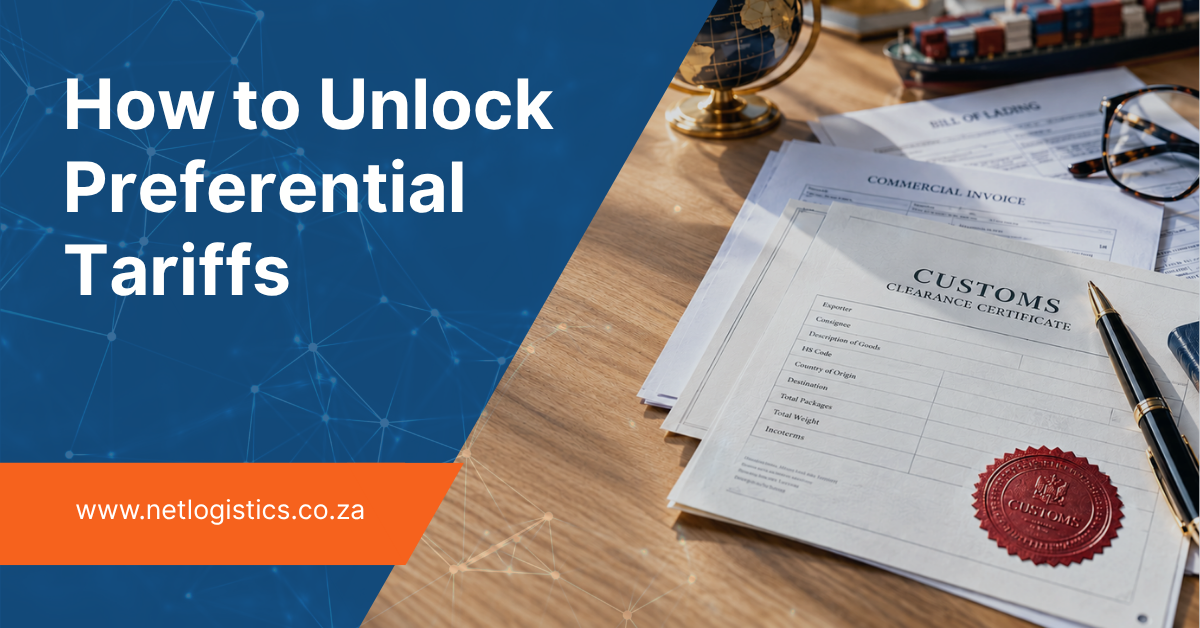
A SADC Certificate of Origin is a powerful statutory commercial tool, allowing South African exports to enter partner countries with little to zero import duty. This critical duty differential is often the deciding factor in whether your export quotes win or lose against international competitors. But regional customs authorities do not hand out these tax exemptions lightly. Unlocking these preferential tariffs requires strict adherence to trade agreements, a deep understanding of manufacturing thresholds, and meticulous administrative execution.
To ensure your cargo clears the border swiftly and your business secures maximum tax benefits, we have put together this comprehensive, step-by-step guide. From understanding the foundational “Rules of Origin” to executing flawless pre-clearance with your freight forwarder, here is exactly how to obtain and complete your SADC Certificate of Origin.
Part 1: The Foundation – Understanding “Rules of Origin”
You cannot claim SADC trade benefits simply because your goods are being dispatched from a South African warehouse. The foundational requirement of the regional trade agreement is that your goods must actually originate within the region to protect and stimulate local economies.
If your products are wholly grown, mined, or extracted in South Africa (such as raw agricultural produce or unrefined minerals), they automatically qualify. However, for most modern exporters, supply chains are complex. If you import raw materials or components from China, Europe, or the Americas to manufacture your final products, those materials must undergo “sufficient industrial transformation” locally to qualify for SADC benefits.
The Value-Add Threshold
What constitutes “sufficient transformation”? Typically, your goods must meet a minimum local value-add threshold, generally sitting between 35% and 45% of the total manufacturing cost.
You cannot simply import finished goods from Asia, repackage them in a box in Johannesburg, and claim they are South African. To prove that you meet the required threshold, you must maintain detailed manufacturing cost sheets. These sheets act as an internal audit, clearly outlining the cost of local raw materials, factory labor, and local operational overheads directly contrasted against the cost of your imported, non-originating materials.
If your cost analysis proves that the local South African manufacturing effort contributes 35% to 45% of the final ex-works price, you pass the test. For a deeper look at how accountants calculate these manufacturing thresholds for cross-border trade, you can review this Customs Certificate of Origin SADC & EUR.1 Guide from MyAcc.
Part 2: Registering as a SARS Exporter
Before you can even look at a SADC certificate application, your business must establish its formal legal standing with the South African Revenue Service (SARS).
Before applying, you must be formally registered as an Exporter and Manufacturer with SARS Customs. You achieve this by completing and submitting Form DA 185 alongside the specific annexure Form DA 185.4A2.
This registration process requires you to submit various corporate documents, including your company registration certificates, proof of address, bank statements, and tax clearance certificates. Once SARS verifies your manufacturing status, you will be issued a unique Customs Client Number (CCN).
This CCN is the administrative backbone of your export business. It is a mandatory prerequisite for all subsequent cross-border documentation, from your commercial invoices to your final certificates. If you try to apply for preferential SADC tariffs without an active CCN linked to manufacturing, your application will be instantly rejected.
For a broader overview of the preliminary registration frameworks and community guidelines, you can consult SA Trade Connect’s guide on completing a SADC certificate.
Part 3: Completing the SADC Certificate
Once you are registered and your goods meet the origin rules, you must physically complete the certificate. The certificate comes as a physical document printed in triplicate.
Regional border authorities are notoriously strict when it comes to the physical completion of this form. Even a minor typographical error, a scratched-out word, or a vague description can result in your truck being detained at Beitbridge or Groblersbrug for days.
Here are the critical sections you must execute with total precision:
Sections 1 & 2: The Exporter and Consignee
You must accurately provide the full Exporter and Consignee details. It is vital that the names, physical addresses, and registration numbers match your commercial export invoices, packing lists, and transport waybills character for character. Discrepancies between your invoice and your SADC certificate raise immediate red flags for customs officials. For a visual breakdown of these specific data fields, see the Trade Logistics Guide to completing SADC certificates.
Section 6: Specific Descriptions
Vague cargo descriptions are not permitted. You must provide a basic description of the goods and packaging. Do not just write “electronics” or “clothing.” You must be specific, noting critical visual details such as “no marks” or providing exact container and seal numbers. The easier it is for a border official to look at Section 6 and immediately identify the cargo in the back of the truck, the faster your freight clears.
Section 7: The Tariff Code Trap
This is where the majority of exporters fail. In Section 7, you are required to list the tariff codes (the 8-digit Harmonized System or HS codes) for your goods.
Crucially, all items on a single certificate must fall under the same 2-digit chapter in the tariff book.
For example, if you are shipping mechanical appliances (Chapter 84) and electrical machinery (Chapter 85) to a client in Lusaka, you cannot put both on the same document. If goods span multiple chapters, multiple certificates are required. Consolidating different tariff chapters onto one SADC document will lead to immediate rejection by customs. The compliance experts at Import Export License provide an excellent deep dive into navigating these strict tariff chapter rules.
Part 4: Securing the SARS Endorsement
A completed SADC certificate holds no legal weight until it is formally authenticated by the state. You cannot print this yourself or sign it off internally.
To finalize the process, you must compile a comprehensive export dossier. Compile the completed physical certificate (which comes in triplicate), the commercial invoice, packing list, and manufacturing cost sheets.
You must present this dossier at a SARS Customs branch for an official embossed ink stamp and signature. A customs officer will physically inspect your documentation, verify your value-add calculations against your manufacturing cost sheets, and cross-reference your CCN to ensure your registration is active.
Once satisfied, the officer will sign the document and apply an embossed, raised-ink stamp. Without this specific embossed stamp, the destination country will not grant the preferential tariff rate. Note that a SADC Certificate of Origin is generally valid for six months from the date of this SARS stamping.
Part 5: The Final Mile – Flawless Logistics and Dispatch
The final step bridges the gap between tax administration and physical logistics. You have done the hard work to secure the paperwork; now you need a logistics partner who won’t drop the ball at the border.
When your goods are ready to move, hand all three copies to your Net Logistics freight agent. The original document must physically accompany the freight, while the remaining copies go to SARS.
Bypassing Border Delays
Infrastructure bottlenecks at regional borders are legendary, but the reality is that the majority of these delays are caused by administrative errors rather than physical traffic. At NET Logistics, we bypass these queues by strictly enforcing pre-clearance protocols. By supplying us with your endorsed SADC certificate, commercial invoices, and transit permits early, our clearing agents submit the Road Freight Manifest to SARS via the Electronic Data Interchange (EDI) system before the vehicle ever departs our yard.
This means your customs declaration is submitted and processed by border authorities before the truck arrives at the physical gate, allowing your cargo to join a “pre-cleared” fast lane.
Choosing Your Transport Strategy
Securing zero-rated duties is only half of the cross-border equation; optimizing your physical transport costs is the other. Once your SADC paperwork is in hand, we offer two distinct pathways to move your freight from our Boksburg dispatch hub to the rest of Southern Africa:
1. Freight Consolidation (Groupage)
If you are moving Less-Than-Truckload (LTL) shipments, general fast-moving consumer goods (FMCG), or retail stock, our consolidation service is the most cost-effective route. You deliver your goods to our Boksburg warehouse, where our team physically weighs, measures, and strategically packs the truck. By sharing space with other shippers, you drastically reduce your baseline transport costs while maintaining high-frequency replenishment cycles.
2. Dedicated Transport Charters
If your shipment is time-critical, exceptionally high-value, or voluminous enough to fill a 34-ton interlink, a dedicated truck is the way to go. This ensures minimal handling and point-to-point transit. We also operate a highly specialized, RTMS-certified fleet capable of transporting hazardous materials (HAZCHEM) with absolute safety and compliance.
Regional Expertise: On the Ground in Zambia and Zimbabwe
A SADC certificate is designed to unlock regional growth, but you need a logistics partner whose footprint matches your ambition. We specialize in dedicated, seamless routes into the heart of the SADC region.
If you are exporting into Harare or Bulawayo, our Transport to Zimbabwe services ensure your cargo navigates the Beitbridge border post with maximum efficiency.
Furthermore, if your target market lies further north, we offer an unparalleled advantage. Unlike standard logistics brokers who hand your freight over to unknown third parties at the border, NET Logistics operates a fully staffed, on-the-ground office in Lusaka. Our Transport to Zambia operations mean that when your freight arrives at its final destination, it is received, managed, and processed by our own dedicated team, guaranteeing accountability right to your client’s door.
Focus on Sales. Let NET Logistics Handle the Borders.
Navigating cross-border compliance, understanding value-add thresholds, and managing SARS documentation can be a daunting process. But by taking the time to ensure your SADC Certificates of Origin are compliant, you secure a massive competitive pricing advantage in the Southern African market.
Your business should be focused on securing new regional clients and scaling your production—not stressing over whether a truck is stuck in a queue because of a tariff code error.
At NET Logistics, we view ourselves as your strategic partner in cross-border trade. We take the friction out of export logistics so you can focus on growth.
Ready to streamline your cross-border supply chain and unlock the full potential of SADC trade?
Contact NET Logistics today to speak to a logistics expert and get a comprehensive quote for your regional freight.