
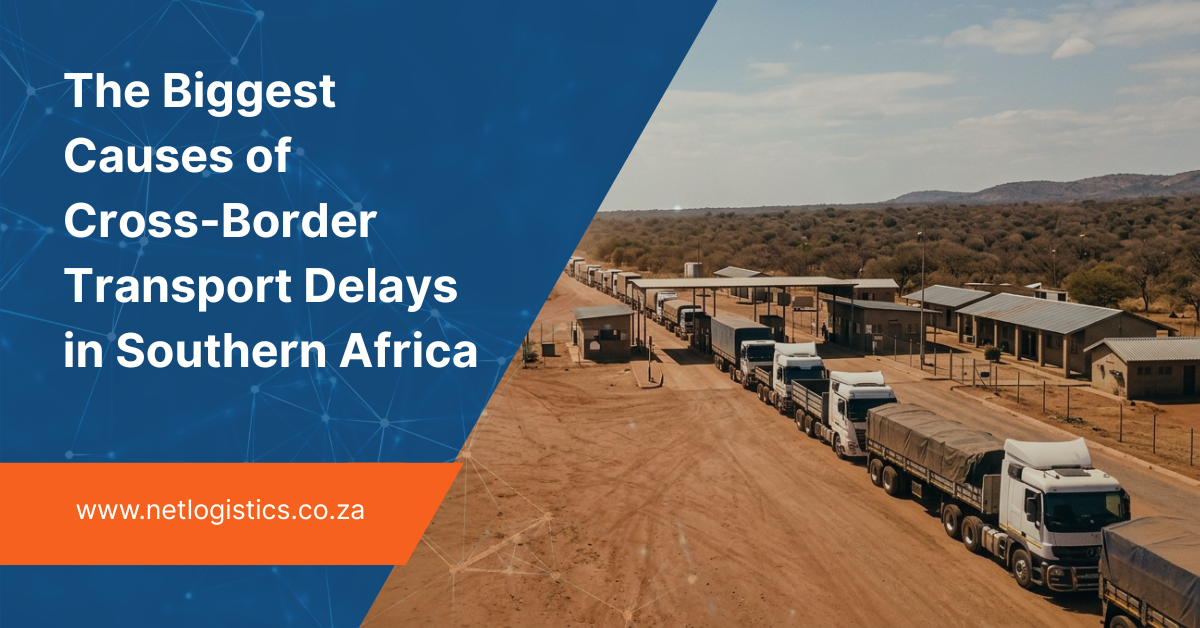
Cross-border transport delays in Southern Africa are one of the most consistent frustrations in regional trade — and one of the most misunderstood. Importers often attribute delays to border congestion or bad luck. The reality is more specific than that, and considerably more manageable once you understand what’s actually driving them.
This post breaks down the major causes of delays across SADC border crossings: what triggers them, which ones are within your control, and which ones require you to plan around rather than prevent. If your supply chain runs between South Africa and Zimbabwe, Zambia, Botswana, or any other SADC destination, understanding these causes is the foundation of building a more reliable freight operation.
Why Delays Happen More Than They Should
Here is a number worth anchoring to: according to SADC’s Regional Infrastructure Development Master Plan, only 25% of transport delays in Southern Africa are caused by physical infrastructure problems — poor roads, inadequate bridges, insufficient parking. The remaining 75% stem from poor facilitation: customs procedures, documentation failures, agency coordination gaps, and administrative backlogs.
That distinction matters. It means the majority of border delays in this region are, in principle, avoidable. Not always by the importer acting alone — but avoidable through better preparation, better partners, and a clearer understanding of what the system actually requires.
The causes below are not equally weighted. Some are common and controllable. Others are structural and unpredictable. Understanding the difference is what separates importers who treat border delays as an occupational hazard from those who actively manage them out of their supply chains.
Documentation Errors — The Most Controllable Cause
Documentation errors are the single most common cause of avoidable border delays across SADC crossings. A wrong value on an invoice, a missing signature, a permit that expired before the truck departed, a description that doesn’t match the physical goods — any of these can stop a shipment cold while the issue is investigated and resolved.
The core documents for most commercial cross-border shipments include the commercial invoice, packing list, road manifest, certificate of origin, and any regulated permits specific to the cargo category. Each document must be internally consistent — values, quantities, descriptions, and consignee details must align exactly across all of them. Customs officials at both ZIMRA (Zimbabwe Revenue Authority) and ZRA (Zambia Revenue Authority) are specifically trained to identify discrepancies between declared values and market values. Undervaluation is taken seriously and triggers reassessment, additional duties, and delay.
For a full breakdown of the specific documents required for cross-border shipments in Southern Africa, see our guide to the top customs clearance documents.
The most reliable way to eliminate documentation errors as a delay factor is pre-clearance — submitting the full document set to customs before the truck reaches the border. When documents are submitted in advance, any errors are identified and corrected while the truck is still in transit, not while it’s sitting in a queue. At NET Logistics, documentation is submitted at least five days before the truck arrives at the border. That window exists precisely to catch problems before they become delays.
Customs Processing Backlogs and System Downtime
Even when documentation is perfect, customs processing itself can introduce delays. Border posts across Southern Africa operate electronic clearance systems — ZIMRA uses its own electronic platform, ZRA uses ASYCUDAWorld — and when these systems experience downtime or connectivity issues, clearance queues back up rapidly.
System downtime is a documented, recurring issue. At Beitbridge, ZIMRA has publicly acknowledged that intermittent network connectivity has historically been a source of process delays — and that Starlink connectivity has been installed to mitigate this. The acknowledgement itself confirms the pattern: technology-dependent clearance processes are vulnerable to infrastructure failures, and those failures cascade into truck queues within hours.
The practical implication for importers: when system downtime occurs at a major crossing, every truck waiting for electronic clearance is affected simultaneously. A backlog that takes three hours to clear under normal conditions can take twelve or more when the system has been down for two hours. There is no way to fully insulate against this — but trucks that arrive with pre-approved documentation are better positioned than those arriving for first-time processing, because the electronic record already exists in the system.
For corridor-specific detail on how the ZRA customs process works on the Zambia route, see our post on importing goods into Zambia from South Africa.
Border Congestion: Infrastructure vs Volume
Border congestion is the most visible form of delay and the one most often misidentified as the primary cause. Long queues of trucks at major crossings look like an infrastructure problem. Sometimes they are. More often, they are a volume management problem — too many trucks arriving in too short a window, without the processing capacity to clear them efficiently.
Beitbridge is the clearest example of what infrastructure investment can achieve. Following its US$300 million upgrade, the border now clears approximately 60% of commercial cargo in under three hours — a dramatic improvement from the previous 24–72 hour norm. But the post still processes close to 300,000 commercial trucks annually, and when peak volumes arrive simultaneously, congestion recurs regardless of the improved infrastructure.
For freight moving on the Johannesburg–Botswana–Zambia corridor, Groblersbrug has become a significant and recurring pressure point. As recently as 27 April 2026, industry publication SA Trucker documented very long queues on both sides of the Groblersbrug Border Post, with drivers reporting that the South African side was the bottleneck — Botswana was clearing trucks efficiently, while vehicles sat waiting on the SA side. One driver put it plainly: trucks were parked there for nothing. This is not an isolated incident — it reflects a persistent capacity and processing gap at a crossing that handles significant northbound commercial freight volume daily, and it has a direct impact on transit times and customer delivery windows on this corridor.
The WCO East and Southern Africa RPSG publishes weekly cross-border reports tracking queue times, crossing times, and delay costs across the region’s major corridors — a useful resource for anyone monitoring live border conditions.
Peak Periods and Predictable Traffic Spikes
Not all congestion is random. Border delays in Southern Africa follow recognisable patterns that importers should factor into their supply chain planning.
Public holidays and long weekends across the corridor — South African, Zimbabwean, and Zambian — generate surges in both passenger and commercial traffic that increase processing times at border posts. School holiday periods have a similar effect on passenger volumes at major crossings, adding pressure to infrastructure that is already running at capacity during normal operations.
These are foreseeable variables. Building awareness of the regional holiday calendar into your delivery commitments and stock planning reduces the likelihood that a predictable surge catches your supply chain off guard.
For a detailed guide to managing delays on the Beitbridge corridor specifically, see our post on how to avoid delays at the Beitbridge Border Post.
Payment Verification and Duty Assessment Disputes
Once customs has assessed the duty payable on a shipment, payment must be verified before a release order is issued. This step is straightforward when everything aligns — the declared value is accepted, the tariff classification is correct, and payment is made promptly. When any of these elements is disputed, the truck waits.
The most common payment-related delays arise from:
Tariff misclassification — using the wrong Harmonised System (HS) code results in an incorrect duty calculation. Customs will reassess and apply the correct rate, adding both time and cost. In some cases, penalties apply for misclassification.
Customs value disputes — where the declared invoice value is below the customs authority’s assessment of market value. ZRA and ZIMRA are both active in identifying undervaluation. Resolving a value dispute requires supporting documentation — contracts, supplier price lists, previous shipment records — which takes time to produce if not prepared in advance.
Foreign exchange availability — in markets where foreign currency access is constrained, payment of duty in the required currency can itself cause delays independent of the assessment process. This is a structural issue in some SADC markets and one that clearing agents familiar with local conditions can navigate more effectively than importers operating at a distance.
Your Clearing Agent Is Part of the Equation
This is a cause of delay that rarely appears in logistics guides but is well known to anyone who moves freight across SADC borders regularly: the responsiveness and cooperation of the importer’s clearing agent has a direct impact on how smoothly a shipment clears.
Here is how the process works in practice. When a consolidated load is ready to dispatch, the freight operator submits a loading authority form to each importer’s clearing agent. That form needs to be completed and returned before the cargo can be manifested, cleared, and loaded. If a clearing agent is slow to respond — or unresponsive — the entire truck can be held up waiting for one consignment’s paperwork to be authorised. In a consolidated load, that delay affects every other importer on the same truck.
Clearing agents are not all equal in how they prioritise this coordination. Some work closely with the freight operator and turn forms around quickly. Others, for various reasons, are slower — and that slowness has a measurable cost in transit time.
The practical implication for importers: your choice of clearing agent is not just a compliance decision. It is a logistics performance decision. When evaluating clearing agents, ask specifically how they handle loading authority requests from freight operators, and whether they have established working relationships with the transporters you use. A clearing agent who communicates proactively and responds promptly to freight operators is worth more to your supply chain than one who handles the paperwork eventually.
If your shipments are consistently running late despite accurate documentation and good departure timing, the clearing agent coordination step is worth examining.
Physical Inspections — What Triggers Them
Not every truck crossing a SADC border gets physically inspected. Customs authorities use risk profiling to select consignments for physical examination — but several factors reliably increase the probability of inspection:
- First-time importers or new trade relationships — customs databases track import history. New importers have no track record and attract more scrutiny.
- Declared values that appear low relative to cargo type — risk profiling flags statistical outliers. If similar goods are consistently declared at higher values, a lower declaration stands out.
- Cargo categories with high regulatory sensitivity — food, pharmaceuticals, chemicals, and agricultural products attract greater scrutiny because of the regulatory frameworks governing them. Phytosanitary checks, veterinary inspections, and Ministry of Health clearances may be required independently of the standard customs process.
- Inconsistencies in documentation — discrepancies between the invoice, packing list, and manifest are one of the most reliable triggers for physical examination.
- HAZCHEM loads — hazardous materials require verification of compliance with transport regulations. Even pre-cleared HAZCHEM loads may be subject to physical inspection of safety documentation and load configuration.
Physical inspection itself takes time — the truck must be positioned, the cargo accessed, the inspection conducted, and the release authorised. Under normal conditions this adds hours. Under high-volume conditions, it can add a day or more.
Regulatory Changes That Nobody Warned You About
This is the delay cause that catches importers off-guard most brutally. Regulatory changes — new import licensing requirements, revised permit categories, updated rebate thresholds — can take effect with limited notice and create immediate, severe congestion at border posts.
A live example: Zimbabwe’s Statutory Instrument 59 of 2026 introduced new licensing requirements for a range of goods previously imported under more flexible terms. The result was immediate congestion at Beitbridge in April 2026, with families and traders stranded and ZIMRA issuing an emergency advisory. The regulation was lawful and announced — but the operational impact on the ground was felt before most importers had adjusted their procedures.
SADC’s Non-Tariff Barriers framework exists specifically to identify and address these kinds of measures. In June 2025, SADC’s Committee on Trade approved a dedicated Technical Working Group on NTBs and directed the Secretariat to accelerate resolution of outstanding barriers. Progress is being made — but the process is slow relative to the pace at which individual member states can introduce regulatory changes.
The practical response for importers: maintain a relationship with a clearing agent and freight operator who monitors regulatory changes actively across the corridors you use. A logistics partner with offices at key border posts — not just at origin — is significantly better positioned to flag emerging issues before they affect your shipment in transit.
What Falls Within Your Control — and What Doesn’t
It is worth being direct about this distinction.
Within your control:
- Documentation quality — accuracy, completeness, consistency across all documents
- Pre-clearance — submitting documents before the truck moves
- Timing — avoiding predictable peak congestion windows where your supply chain allows
- Timing awareness — understanding that public holidays and long weekends across the corridor create foreseeable surges, and factoring these into delivery commitments and stock planning
- Partner selection — working with a freight operator that has eyes on the ground at key border posts, not just at the Johannesburg warehouse
- Clearing agent selection — your clearing agent’s responsiveness to freight operators directly affects loading, manifesting, and border clearance timelines. Choose one who coordinates actively, not one who works in isolation
Not within your control — but manageable through preparation:
- System downtime at border posts
- Peak-period congestion caused by other operators’ volume
- Regulatory changes introduced by sovereign governments
What a good freight partner absorbs on your behalf:
- Real-time monitoring of border conditions and system status
- Pre-clearance coordination across both sides of each border
- Local clearing agent relationships that resolve issues faster than remote intervention
- Rerouting decisions when corridor conditions deteriorate
The difference between a seven-day transit and a twelve-day transit on the same route often comes down to whether a problem was caught before the truck moved or after it arrived at the border. That is fundamentally a preparation and partner quality issue — not a matter of luck.
If you want to understand how consolidated freight and pre-clearance work together to reduce delay exposure, see our post on freight consolidation for cross-border transport in Southern Africa.
Delays cost money. The right partner reduces them.
NET Logistics runs cross-border freight into Zimbabwe and Zambia with regional offices at key border posts — Musina, Beit Bridge, Harare, and Lusaka. Our pre-clearance process, local clearing agent network, and real-time tracking mean that when border conditions change, your shipment has support on the ground to respond.
📞 (011) 826 7176 ✉️ pierre@newent.co.za 🌐 www.netlogistics.co.za