
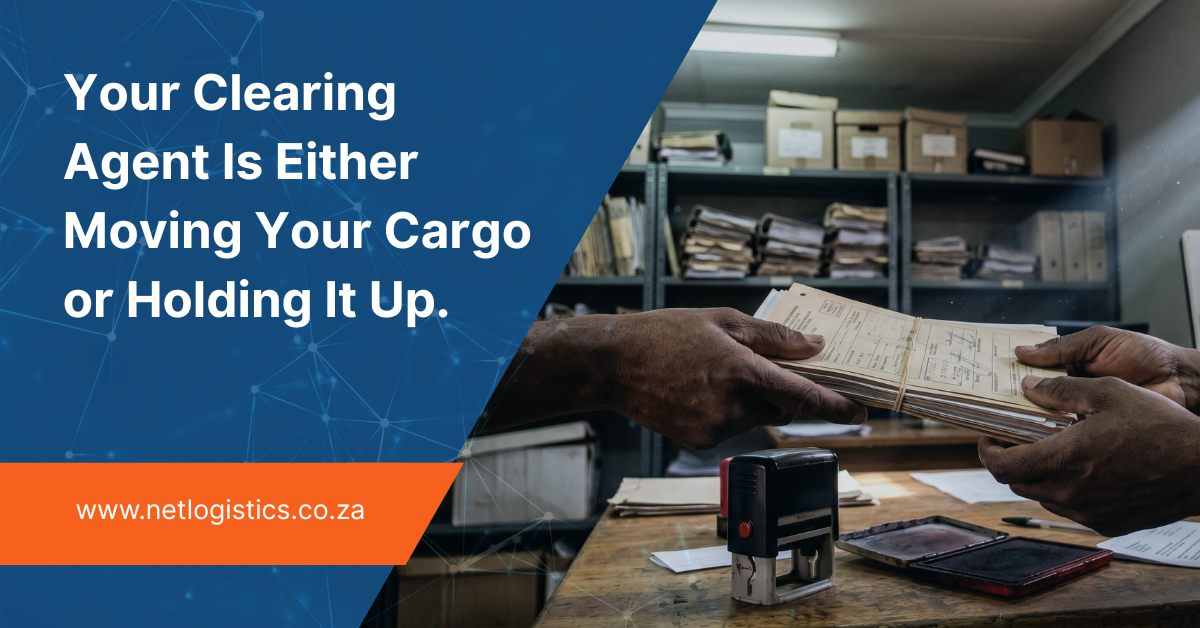
How you choose a clearing agent for Zimbabwe or Zambia shipments is one of the most consequential logistics decisions you make as an importer — and most SMEs make it once, at the start, and never revisit it. That is a problem. Your clearing agent is not a fixed-cost admin function. They are a performance variable. When they are good, your cargo clears predictably and on schedule. When they are slow, unresponsive, or poorly connected at the border, the costs are real: trucks sitting at Beitbridge or Kazungula at $200 to $500 per day in losses, cargo held in limbo, and supply chains that miss delivery windows through no fault of the road freight operator.
This post lays out how to evaluate a clearing agent on both corridors — what to look for, what to ask, and how to know when it is time to make a change.
Why Your Clearing Agent Is a Performance Variable, Not a Fixed Service
The role of a clearing agent is to prepare and submit the customs declaration, manage compliance requirements, and coordinate with customs authorities to get your cargo released. On paper, it sounds like an administrative role. In practice, the difference between a competent, well-connected clearing agent and a slow one is the difference between a truck that crosses the border on day one and a truck that sits in a queue for three days waiting on paperwork.
ZIMRA has said it directly: engaging clearing agents allows for pre-clearance, which significantly reduces delays at border posts. That is not a marketing line — it is an operational reality that the Zimbabwe Revenue Authority itself promotes because the data supports it. Commercial cargo that arrives at Beitbridge without pre-clearance in place competes for attention with every other truck that did the same. Cargo that arrives with a submitted, assessed, and approved declaration moves through designated clearance channels and gets released faster.
The same logic applies at Kazungula on the Zambia corridor. Pre-clearance via ASYCUDAWorld, Zambia’s digital customs system, is the baseline for efficient commercial clearance. An agent who is not submitting five or more days ahead of arrival is not managing your clearance — they are reacting to it.
When you select a clearing agent, you are selecting the pace of your border crossing. Evaluate accordingly.
What Changed in 2026 — and Why Agent Quality Matters More Now
The compliance environment on both corridors tightened significantly in the first quarter of 2026, and the margin for error in clearing agent performance narrowed with it.
In Zimbabwe, Statutory Instrument 59 of 2026, implemented in late March, introduced licensing requirements for a wide range of goods that had previously moved under flexible terms. The immediate impact at Beitbridge was significant: buses left trailers on the Zimbabwean side, goods were seized from traders who were unprepared for the new requirements, and ZIMRA issued an advisory urging importers to use licensed clearing agents and pre-clearance facilities. Approximately 600 trucks cross Beitbridge daily. In April, dwell times for commercial vehicles in some cases stretched to seven days.
An experienced clearing agent who was tracking the SI 59 of 2026 implementation could prepare their clients’ documentation accordingly. One who was not created expensive surprises at the border.
In Zambia, the regulatory environment moved in a different direction — professionalisation rather than restriction. The Global Alliance for Trade Facilitation completed a standardised training and certification programme for Zambian clearing agents, with over 300 agents completing accredited courses. The Zambia Revenue Authority now runs a 2026–2028 licensing cycle with updated requirements, and publishes a list of licensed agents on its website. Importers can appoint up to five clearing companies electronically via the ASYCUDAWorld appointment module — and can replace them if performance falls short.
The message from both countries is the same: the quality of your clearing agent is now a measurable, manageable factor in your logistics performance. Treat it that way.
How to Evaluate a Clearing Agent on the Zimbabwe Corridor
The Zimbabwe corridor runs through Beitbridge — the primary commercial crossing between South Africa and Zimbabwe — for cargo moving from Johannesburg to Harare and beyond. Your clearing agent needs to be licensed by ZIMRA, connected to the ASYCUDA World digital submission system, and actively operating at Beitbridge, not managing clearances remotely from Harare or Johannesburg.
The questions that determine whether your agent is performing or simply present:
Do they submit pre-clearance documentation before your truck arrives at the border? Pre-clearance is not optional for commercial cargo — it is the mechanism that separates predictable clearance from reactive queue management. If your agent is submitting on the day of arrival or after, they are not pre-clearing. They are waiting.
Do they have direct relationships at Beitbridge? Physical presence at the border post matters. An agent who communicates with ZIMRA officers regularly and knows the process intimately at that specific crossing handles exceptions — system outages, documentation queries, inspection flags — faster than one operating at a distance.
How do they communicate with your freight operator? When a freight operator’s truck is approaching the border, the clearing agent needs to be reachable and responsive. Delays in responding to documentation queries from the freight side translate directly into dwell time at the border. This is not about working hours — cross-border freight does not stop at 17:00. Your clearing agent’s responsiveness to the freight operator is a direct input into your transit time.
Are they tracking Zimbabwe’s regulatory changes? SI 59 of 2026 is one example. ZIMRA regularly updates import controls, duty schedules, and compliance requirements. An agent who is not actively tracking these changes will create clearance problems on goods that should clear cleanly.
For a detailed breakdown of the Zimbabwe customs clearance process itself, see our guide to how customs clearance works when importing into Zimbabwe.
How to Evaluate a Clearing Agent on the Zambia Corridor
The Zambia corridor runs from Johannesburg via Groblersbrug, through Botswana, and crosses into Zambia at Kazungula before continuing to Lusaka and, for full loads, further into the Copperbelt — Kitwe, Ndola, Solwezi, Lumwana. Your agent on this corridor must be ZRA-licensed, ASYCUDAWorld-registered, and operating at Kazungula as the port of entry.
The same evaluation principles apply, with Zambia-specific additions:
Are they on ZRA’s licensed clearing agent list? This is publicly verifiable. The ZRA publishes its list and runs an annual licensing process. An unlicensed agent operating outside this framework creates compliance exposure for you as the importer, not just for them.
Do they submit the Bill of Entry via ASYCUDAWorld before your truck arrives? The ZRA assesses duty on submission, issues a release order if the declaration is accepted, and triggers additional assessment and automatic penalties for incorrect declarations. Pre-submission is not just about speed — it is about accuracy. An agent who submits correctly and on time avoids the additional assessment loop that adds days to clearance.
Are they familiar with commodity-specific requirements for your cargo type? Zambia applies specific controls to certain product categories including agricultural inputs, pharmaceuticals, chemicals, and food products. An agent who primarily handles general cargo may not have the specialist knowledge to manage clearance on restricted or controlled categories without delays.
For a step-by-step guide to the Zambia customs clearance process, see how to clear customs in Zambia.
When to Switch Agents — and How to Do It Without Disrupting Your Supply Chain
The practical challenge with replacing a clearing agent is timing. You do not want to switch mid-shipment or when you have cargo in transit. The right time to make a change is between shipment cycles, with enough lead time for the new agent to be appointed and tested on a low-risk consignment before they handle your regular volume.
In Zambia, the process is straightforward. The ASYCUDAWorld appointment module allows you to appoint a replacement agent electronically and remove the previous one. You can hold up to five active appointments simultaneously, which means you can run a new agent in parallel before fully transitioning — a sensible approach if you are moving significant regular volume.
In Zimbabwe, ZIMRA’s licensed agent list is your starting point for verification. Your freight operator can provide a recommendation based on performance at Beitbridge — they deal with clearing agents daily and have direct visibility of which agents move efficiently and which create friction.
One signal that justifies a review: if you are regularly receiving notification that your truck has arrived at the border but clearance is still pending, and that pattern holds across multiple shipments, your clearing agent is not pre-clearing. They are reactive. That pattern is worth addressing before it becomes a supply chain problem.
For a broader look at what causes cross-border delays beyond the clearing agent, see our post on how to avoid delays at the Beitbridge Border Post and five mistakes SMEs make when importing into Zimbabwe.
The Loading Authority Problem Most Importers Don’t Know About
There is a specific documentation issue that causes avoidable delays in the consolidation environment, and it rarely gets discussed openly because it sits in the gap between the clearing agent’s responsibility and the transporter’s operation.
When cargo is booked into a consolidated load, the transporter needs a completed loading authority from the clearing agent before the cargo can be planned onto a truck. The loading authority is what allows the transporter to assign the right cargo to the right loading tray, paired with compatible freight, on the next available consolidated departure. Without it, the cargo cannot be loaded — regardless of how ready the truck is or how well the rest of the consolidation is planned.
When a clearing agent submits this documentation late — even by a few hours — the cargo can miss its planned truck entirely. That means waiting for the next available consolidation, which on a two-week cycle has a direct impact on delivery timelines at the destination. The importer waits longer. The supply chain absorbs a delay it should not have had.
What makes this particularly frustrating is where the blame tends to land. The end customer sees that their cargo has not arrived on schedule and contacts the transporter. The transporter carries the reputational weight of a delay they did not cause. The source of the problem — incomplete or late documentation from the clearing side — is invisible to the importer unless someone explains it clearly.
This is not an argument against clearing agents. It is an argument for choosing clearing agents who treat loading authority documentation with the same urgency they apply to the customs declaration itself, and for working with a freight partner who will tell you honestly where a delay originated rather than absorbing the blame silently.
Strong communication between transporters, clearing agents, and importers is not a nice-to-have. On a consolidated corridor where multiple importers share a truck and one documentation failure affects every consignment on that load, it is an operational requirement.
How NET Logistics Manages This for Its Clients
NET Logistics holds regional offices at Beit Bridge, Musina, Harare, and Lusaka — positioned directly at or adjacent to the border posts where clearing takes place on both corridors. That physical presence is not incidental. It means clearing agent relationships are managed on the ground, in real time, by people who are at the border regularly and who know the operational landscape at each crossing.
Pre-clearance documentation is submitted a minimum of five days before a truck reaches the border. That is not a target — it is a process standard. It gives clearing agents adequate time to submit, have the declaration assessed, resolve any queries, and have a release order in place before the truck arrives.
For SME importers who are consolidating cargo — sharing truck space with other importers on the same corridor — this matters particularly. A delay caused by one consignment’s documentation affects the entire load. NET Logistics coordinates documentation across all consignments in a consolidation to ensure pre-clearance is complete for every importer on the truck, not just the ones who had their paperwork ready early.
If you want to understand what this looks like for your specific cargo and corridor, get in touch.
Phone: (011) 826 7176
Email: pierre@newent.co.za
Website: www.netlogistics.co.za