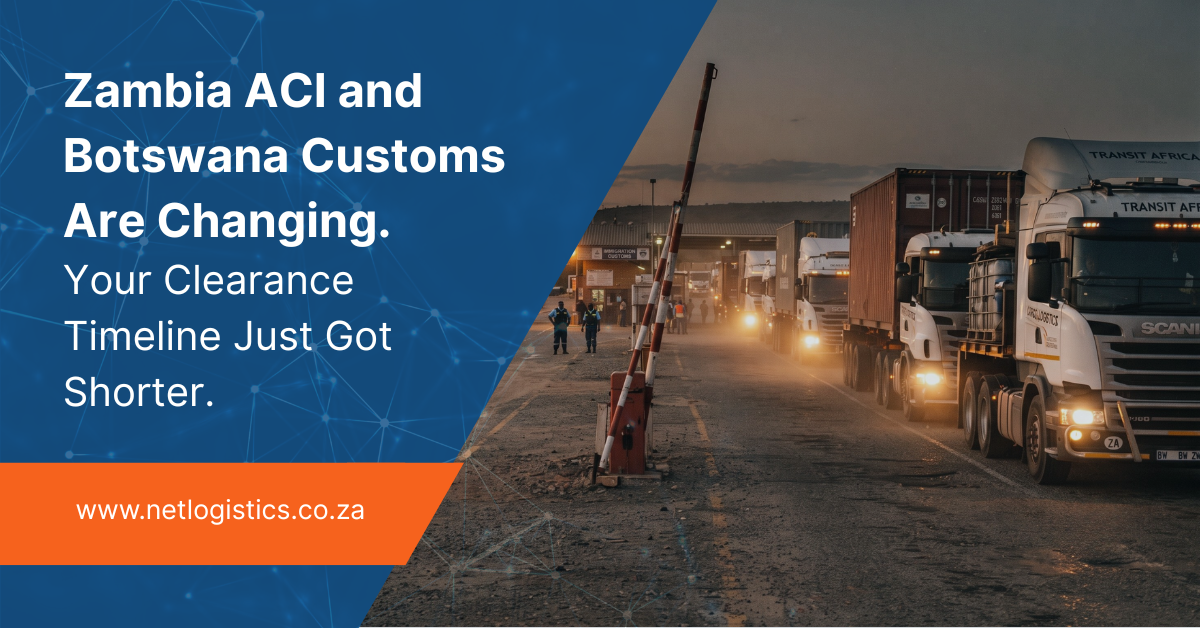
The Zambia Revenue Authority’s new Advance Cargo Information system is live. If you’re still moving goods into Zambia without pre-submitting cargo details, your shipments are sitting at the border waiting for clearance that should have happened before you arrived.
In the coming weeks, Botswana adds its own requirement: pre-lodgement of customs declarations. Another system. Another timeline to manage. Another chance to miss the window and watch your goods queue at the border while competitors’ shipments clear.
This isn’t abstract regulation. It’s operational reality hitting your supply chain right now.
Why This Matters Right Now
Customs clearance already takes time. Current process: 3–5 days if everything is in order. Now both countries are demanding advance submission. The mechanics have shifted. Speed is no longer about having good paperwork at the border—it’s about submitting the right paperwork before your truck arrives.
Get this right and your goods clear in hours instead of days. You save warehousing fees, demurrage charges, and avoid penalties. Get it wrong and your shipment sits. In Zambia, it sits until ACI is submitted. In Botswana, late submission triggers fines up to P10,000 (roughly ZMW 4,500).
For SMEs running on tight margins, this is not a compliance problem. It’s a cost problem.
What Actually Changed
Zambia (Now in Effect):
The ZRA now requires Advance Cargo Information—electronic submission of cargo details before goods arrive at any border post or port. All clearing agents, freight forwarders, and importers must comply. No exceptions. No grace period.
You submit a form (Form CE1) via email to the ZRA port assigned to your crossing. The form captures vehicle registration, cargo description, HS codes, shipper details, declared value, bill of lading reference, and any required permits. ZRA screens it, flags risks, and issues a “Proceed to Border” clearance before your shipment physically arrives.
If you arrive without this clearance, your goods are held until you submit ACI retroactively. Which means delay, which means cost.
Botswana (Coming Soon):
BURS is launching mandatory pre-lodgement of customs declarations. Before your shipment crosses the border, you submit your full customs declaration and supporting documents electronically through the BURS Single Window platform. BURS reviews, approves (or requests clarification), and clears your goods for arrival.
Compliant shipments can cross with minimal inspection. Non-compliant or late submissions face holds and penalties up to P10,000.
The Real Impact on Your Timeline
This is where most compliance articles stop and just tell you to follow the rules. That’s not useful. Here’s what actually happens:
Zambia: You have goods arriving at Kazungula tomorrow. Under the old system, you’d brief your clearing agent, they’d handle it at the border, and customs would clear you in 1–2 days. Now, you need ACI submitted before arrival. If you haven’t submitted yet, those goods sit. You’re looking at 24–48 hours of additional delay while ACI is processed and approved. Your demurrage clock starts immediately. That’s real money.
Botswana: Goods arriving Monday morning. You need pre-lodgement filed by Friday afternoon at the latest. BURS takes 1–2 working days to review. If your documentation has errors—wrong HS code, missing invoice detail, inconsistent shipper name—BURS comes back asking for clarification. That’s another 1–2 days added to your timeline. You’re now at 3–4 days of processing before the truck even reaches the border.
If you don’t pre-lodge at all, you arrive at the border and BURS refuses to process you on the spot. Hold at the border. Penalties. Demurrage charges.
For consolidation shipments moving multiple customers’ goods, this compounds. One customer’s documentation error delays the entire shipment.
How These Systems Actually Work
Zambia ACI Submission (The Practical Reality)
You gather your documentation: commercial invoice, packing list, HS codes. This is non-negotiable. Misclassified HS codes are the #1 reason submissions get rejected.
You download Form CE1 from ZRA’s website. You fill in every field. Vehicle registration, border post, cargo description, shipper details, declared value, bill of lading, any permits required. Incomplete form equals automatic rejection.
You email the completed form to the ZRA port assigned to your crossing. The email subject line follows a specific format: [Vehicle Registration]/[Border Post]/[Date].
Example: BAD787ZM/ALG101T/ALG101/KAZUNGULA/14.07.2026.
This format isn’t bureaucratic theatre—it’s how ZRA sorts submissions. Wrong format, your email gets buried.
You receive a confirmation. That’s your proof of submission. Save it.
Within 24 hours (sometimes same-day), ZRA sends “Proceed to Border” clearance. That’s your signal to move the truck. If you arrive before receiving this, customs will hold your goods.
At the border, you present the clearance confirmation. Goods release.
This process works if you submit 24 hours before arrival. Submit same-day and you’re gambling on ZRA’s response time. Submit after arrival and you’re already delayed.
Botswana Pre-Lodgement (The Practical Reality)
You access the BURS Single Window platform. If you don’t have an account, register now. Waiting until the deadline means delays on day one.
You prepare your declaration and supporting documents: invoice, packing list, bill of lading, import duty proof (if applicable), import licence or permit (if required), certificate of origin (for SACU/COMESA preference claims).
You upload everything through Single Window. BURS generates a lodgement reference number and initial status check.
BURS reviews your submission over 1–2 working days. If something’s wrong—HS code mismatch, shipper details inconsistent, missing document—they email requesting clarification. You respond. They review again. That’s another day or two.
Once approved, you receive “Cleared for Arrival” status. That’s your signal. The truck moves to the border. Physical inspection may be waived for pre-cleared, compliant shipments.
This works if you submit 48 hours before arrival. For Monday arrival, you lodge by Friday afternoon. Friday evening submissions get reviewed Monday morning—now your approval comes the day of arrival, not before. You’ve lost the buffer.
The Dual-Country Problem
If your shipment crosses both Zambia and Botswana, you submit to both systems. Different platforms, different timelines, different document requirements. One error in Zambia Form CE1 holds you up. One error in BURS pre-lodgement holds you up. Both are live now (or live soon).
SME importers managing multiple SKUs across multiple suppliers already juggle documentation chaos. Now they’re managing two separate regulatory submission windows with penalties for missing either one.
What to Do (Starting Today)
This week:
Audit your current import process. Are you currently submitting Form CE1 for Zambia shipments? If not, you’re operating illegally. Start immediately.
Verify your HS code classifications. Get this wrong and both systems reject you. Spend the time now.
Brief your freight forwarders and customs brokers. Ensure they know ACI is mandatory and BURS pre-lodgement is coming. If they’re still working under old procedures, you have a problem.
Get the email address for your primary ZRA border crossing. Don’t hunt for it on a deadline. Call ZRA Call Centre or visit the ZRA Customs section and save the contact.
Before Botswana’s Deadline:
Access the BURS Single Window and confirm your account is active. Register if you don’t have one. Waiting until the last minute means delays on day one.
Review BURS pre-lodgement requirements on their website. Understand what documents they actually require for your goods category.
Adjust your shipment scheduling. Add 2–3 days processing buffer for pre-lodgement. If goods arrive Monday, they need to be lodged Friday. If you’re consolidating multiple shipments and waiting for the last SKU to arrive, you compress the window.
Create standard documentation templates: invoices with correct HS codes, packing lists formatted the way BURS expects, shipper/consignee detail sheets. Standardised docs reduce errors and speed submission.
After Implementation:
Track your clearance status in real-time. ZRA has a CRMS portal (Taxpayer Relations → Customer Service Portal) where you can lodge queries and track tickets. BURS has your Single Window account. Use them. If you’re held at the border and don’t know why, file a query immediately instead of waiting.
Keep compliance records. Save email confirmations of ACI submissions, “Proceed to Border” notifications, pre-lodgement reference numbers, clearance confirmations. These are your proof if disputes arise.
Review your processing times quarterly. If clearances consistently take longer than expected, investigate. Often it’s documentation errors, not system delays.
How NET Logistics Handles This
We operate across Zambia, Botswana, Zimbabwe, Namibia, and Malawi. We’re integrated into both ACI and BURS workflows already.
On your behalf, we complete Form CE1, submit to the correct ZRA port, track “Proceed to Border” confirmation, and alert you when clearance approves. We lodge your BURS pre-lodgement, monitor review status, and confirm approval before goods arrive. We track your shipment through both ZRA CRMS and BURS portals, flag any holds immediately, and resolve issues in real-time.
We verify HS codes before submission (no surprises at the border), ensure documentation is complete, and catch errors before they become delays.
Your goods clear before arrival. No border holds. No demurrage charges. No penalties for non-compliance.
Navigating two separate regulatory systems simultaneously shouldn’t mean managing chaos. That’s what we do.
Final Reality
The ZRA system is already live and operating. Botswana’s requirement is coming. If you’re not integrated into both systems yet, your upcoming shipments will struggle.
This isn’t a future problem. It’s happening now.
Contact NET Logistics to review your current compliance setup. We’ll walk through your process, identify gaps, and show you how to cut clearance delays in half while staying compliant with both jurisdictions.
When choosing a cross-border freight partner, regulatory expertise and proven regional integration matter. Your competition is already moving. Don’t fall behind.
Ready to simplify regional compliance?
Contact NET Logistics today.